
Governance
Rules-in-Use: Overview
Introduction: Rules-in-use
The Telcoin “rules-in-use” are the working rules for how Miners order their interactions with the Telcoin Platform and with each other in social processes. There are three levels of vertical, rule-ordered authority in the Telcoin governance system, including the operational, collective and constitutional-choice levels of analysis. The outcomes of choices made at higher levels of governance are rules that structure interactions at the lower levels.
Definition: Rules-in-use
- Rules-in-use: Formal rules (e.g. legal and platform rules) and norms (e.g. Association values) that shape interactions with the Telcoin Platform and govern social interactions between Telcoin stakeholders.
Overview: Rules-in-use
- Operational-choice Rules: The set of rules about everyday activities, directly involving the use of various resources related to the Telcoin Platform and day-to-day social interactions. These rules change frequently, and are determined by Miner Councils in collective-choice processes. Rules set includes:
- Collective-choice Rules: Rules set used to change the operational-choice rules, including council member selection rules and miner council decision-making rules. These rules change at a slower pace, and are set in constitutional-choice processes by Miner Groups and the broader Miner Assembly.
- Council Member Selection Rules: The set of rules that structure the processes by which Miner Groups select and remove Council Members to represent their interests on Miner Councils, including:
- Miner Council Decision-Making Rules: In order to make collective-choice decisions that determine and enforce operational rules within their domain of authority, Miner Councils are required to use specific processes, including the:
- Constitutional-choice Rules: Rules used to set the terms and conditions of governance, including the set of rules about how to change the collective-choice rules and about who occupies certain key positions at the collective-choice level. These rules change at the slowest pace, and are set and refined by the community based on their needs, viewpoints and traditions (which are articulated as "Values" in the Telcoin Association Constitution) that determine what kinds of rules at the lower levels are seen and accepted as legitimate. Rules include:
- Meta-Constitutional Rules (”Association Values”): Moral intuitions, social norms, and traditions that determine what kinds of rules at the lower levels are seen and accepted as legitimate. The Telcoin Association Constitution, adopted and ratified by the community in TGIP1, articulates a Mission, Vision, and set of Values to serve as a guidepost for the community to ethically order its behavior towards a common cause, vision for the future, and set of moral standards. While the other levels of governance have sanctioning mechanisms in place, these do not.
Rules-in-use: Visualization
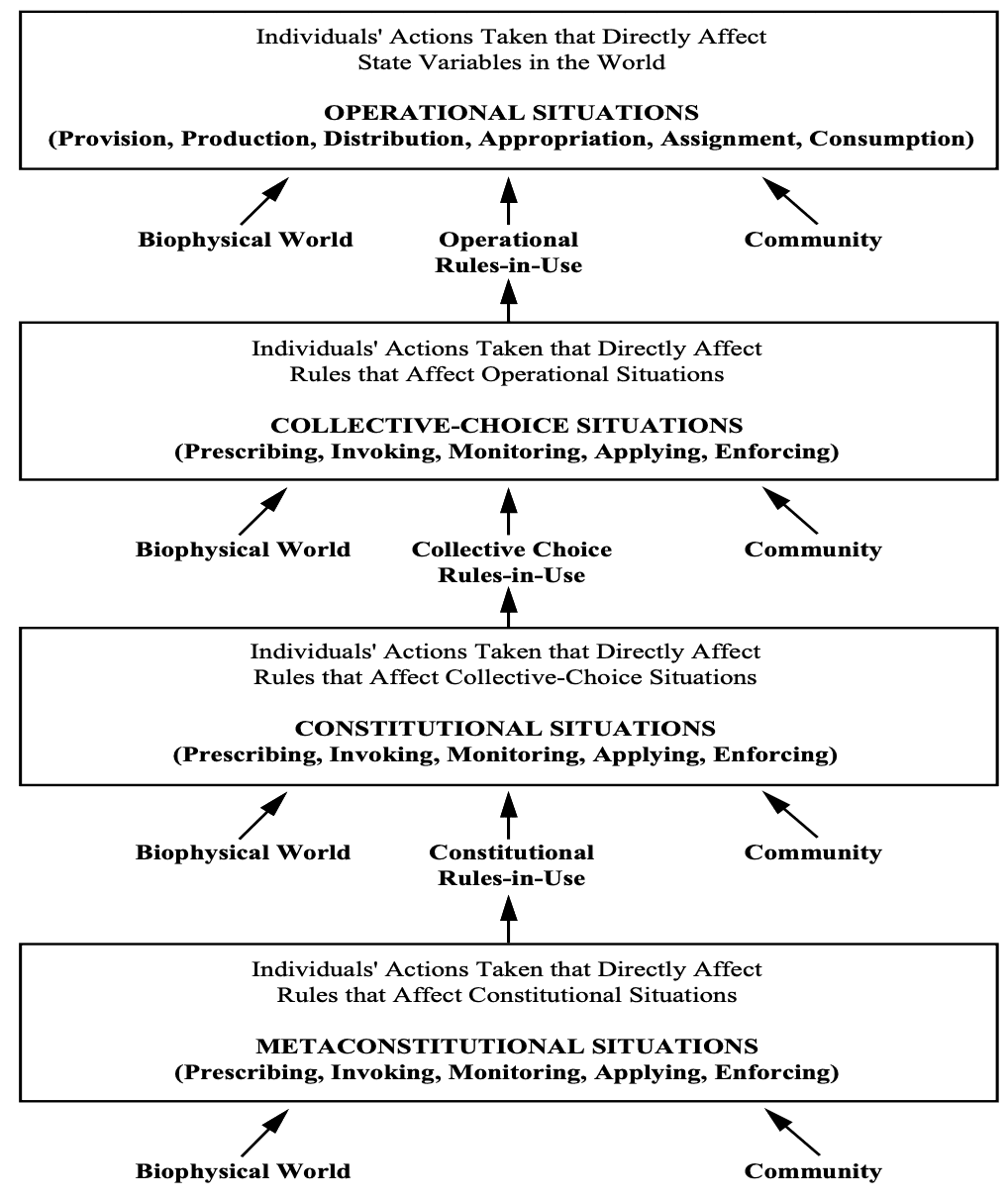
Definitions
Rules
Shared understandings by participants about enforced prescriptions concerning what actions (or outcomes) are required, prohibited, or permitted.
All rules are the result of implicit or explicit efforts to achieve order and predictability among humans by creating classes of persons (positions) who are then required, permitted, or forbidden to take classes of actions in relation to required, permitted, or forbidden outcomes or face the likelihood of being monitored and sanctioned in a predictable fashion.” (Institutional Diversity, E. Ostrom)
Rules: Vertical
The rules used by participants to at various levels of analysis including:
- Operational Rules: Rules that structure day-to-day decisions concerning who gets what when and why.
- Collective-choice Rules: Rule systems used to change the operational rules.
- Constitutional-choice rules: The rules for how the collective-choice rules are altered and refined.
- Meta-constitutional-choice rules: Moral intuitions, social norms, and traditions that determine what kinds of rules at the lower levels are seen and accepted as legitimate.
Rules: Horizontal
Using the IAD framework as a conceptual map, within each set of rules-in-use, we classify each type of rule based on the categories presented in the IAD framework horizontal approach.
- Position rules specify a set of positions, each of which has a unique combination of resources, opportunities, preferences, and responsibilities.
- Boundary rules specify how participants enter or leave these positions.
- Choice rules specify which set of actions is assigned to which position.
- Aggregation rules specify the transformation function from actions to intermediate or final outcomes. (e.g. decision-making rules)
- Scope rules specify a set of outcomes.
- Information rules specify the information available to each position.
- Payoff rules specify how benefits and costs are required, permitted, or forbidden to players.